

State Farm’s $1.4B Claim Savings: What Homeowners Must Know

State Farm’s $1.4 Billion in Claim “Savings”: Why Homeowners Should Pay Attention

A case out of Oklahoma should get the attention of homeowners everywhere, including here in Arizona.

Recently unsealed court documents show that State Farm calculated approximately $1.4 billion in claim-payment savings during the first full year of a program involving wind and hail claims.

The documents are part of lawsuits accusing State Farm of changing its claim-handling process to reduce payouts. State Farm disputes those claims, and the case is still being litigated. The court has not determined that the $1.4 billion represents money that should have been paid to policyholders.

But the documents raise a question every homeowner should be asking:

When an insurance company “saves” money on claims, how are those savings being achieved?

According to the court documents, State Farm calculated that reducing the roof replacement approval rate by just one percentage point would save the company approximately $78.8 million annually.

One percentage point.

That number shows the financial impact claim-handling decisions can have for an insurance company. For an individual policyholder, a repair-versus-replace decision, an omitted item, or a coverage determination can change a claim by thousands of dollars.

When those decisions are applied across thousands of claims, the financial impact adds up quickly.

Your Premium Is Only Part of the Story

For Arizona homeowners already facing higher premiums, deductibles, and changes in coverage, this case is another reminder to look beyond what you’re paying and understand what your policy actually covers. Don’t judge your insurance by the premium alone.

You can pay a higher premium this year while having a higher deductible or less coverage than you had last year.

Changes can include:

  • Higher deductibles
  • Separate wind or hail deductibles
  • Changes to roof coverage
  • New exclusions or limitations
  • Changes to replacement cost coverage
  • More restrictive policy language

Price matters when choosing insurance, but it shouldn’t be the only factor.

A lower premium isn’t necessarily a better deal if a difference in coverage leaves you responsible for thousands of dollars after a loss.

The Insurance Company’s Estimate Is Not Automatically What Your Claim Is Worth

An insurance estimate is based on the scope of work included.

Change the scope, and you change the claim amount.

If damaged materials or necessary repairs are left out, the estimate is lower. If damaged property is considered repairable instead of replaceable, the estimate is lower. If the insurance company determines the damage is wear and tear rather than covered storm damage, it may not pay for it at all.

An estimate can be mathematically correct and still be too low if the scope of work is incomplete.

What Should Homeowners Do?

When your renewal arrives, keep last year’s policy nearby and compare the declarations page, deductibles, and endorsements. Don’t assume the coverage stayed the same because you stayed with the same insurance company.

If something changed and you don’t understand it, ask your insurance agent to explain it in writing.

If you have a significant property loss, understand who represents whom.

The insurance company’s adjuster represents the insurance company. A licensed public adjuster represents you, the policyholder.

At AJR Public Adjusters, we prefer to become involved at the beginning of a claim. This lets us review your policy, document the full extent of the damage, and develop and present the scope of loss before key claim decisions are made.

The Bottom Line

The State Farm case gives homeowners a look at something they rarely see: the financial impact that claim-handling decisions can have when applied across thousands of claims.

The $1.4 billion figure is what made headlines. For homeowners, the bigger lesson is what happens one claim at a time.

Know what your policy covers. Know what changed at renewal. And when you have a loss, make sure the full scope of your damage is being considered.

Because what you pay for insurance matters. What happens when you need to use it matters more.

AJR Public Adjusters
We represent the policyholder, not the insurance company.
602-795-5227
publicadjusteraz.com

About the Author

Stacy K. Horowitz is co-owner and manager of AJR Public Adjusters, an Arizona public adjusting firm serving homeowners and business owners with property insurance claims. Stacy writes about insurance claims to help policyholders better understand the process, their coverage, and the importance of having someone representing their interests when dealing with an insurance company.

Image Disclosure: The image used in this article was AI-generated for illustrative purposes and does not depict a specific State Farm office or location involved in the matters discussed.
Why Two Estimates for the Same Insurance Claim Can Be Thousands of Dollars Apart

Why the scope of damage matters just as much as the price of repairs

For example, imagine your home suffers significant water damage.

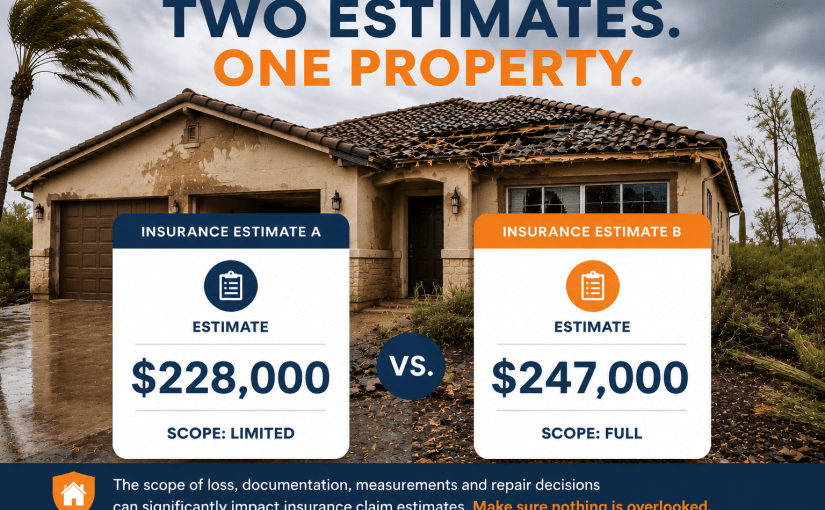
One estimate says the repairs will cost $228,000.

Another says $247,000.

That is almost a $20,000 difference for what looks like the same loss.

Most homeowners would naturally wonder how two people could look at the same property and come up with numbers that far apart.

The answer is often not simply the price of labor or materials.

It may be what each person believes is necessary to complete the repairs.

In insurance claims, that is often referred to as the scope of loss. In plain English, it is the detailed list of work needed to repair the damage.

Here is a clear description of Scope of Loss from United Policyholders (UP), a non-profit 501(c)(3) whose mission is to be a trustworthy and useful information resource and a respected voice for consumers of all types of insurance across the United States. They don’t sell insurance or take money from insurance companies. They give you the straight scoop….Guide you on buying insurance and navigating claims…Fight for your rights.

And that scope of loss list matters just as much as the prices attached to it.

Ideally, you shouldn’t have to get to the point where you’re trying to figure out why two estimates are so far apart. Understanding how estimates are built also helps explain why we believe a public adjuster can be most helpful when involved from the beginning.

Start With the Work, Not the Number

Take a water-damaged kitchen.

You may walk in and immediately see wet flooring and damaged drywall. But repairing that kitchen may involve much more than what you can see.

Are the cabinets damaged? Does the countertop need to be removed to work on them? Is there damage behind the cabinets? Does insulation need to be replaced? Do appliances have to be disconnected and moved?

And once damaged materials are removed, what has to be done to put everything back together?

Those questions all affect the estimate.

So when one estimate is $228,000 and another is $247,000, looking only at the totals does not tell you very much.

The better question is:

Are both estimates actually including the same work?

A Difference in Scope Can Create a Big Difference in Price

Suppose one estimate includes replacing 2500 square feet of flooring and another includes 2900 square feet.

Even if both use exactly the same price per square foot, the totals will be very different.

That is not really a disagreement about the price of flooring. It is a disagreement about how much flooring needs to be replaced.

The same thing can happen with drywall, paint, cabinets, insulation, trim, roofing and other repairs.

The differences can add up quickly.

The Repair May Involve More Than What Was Damaged

If water damaged drywall behind built-in kitchen cabinets, you cannot repair the wall without getting to it. That may mean removing cabinets or a countertop, repairing the wall and then putting everything back.

The same thing can happen when plumbing inside a wall needs to be accessed. The wall may have to be opened and later repaired, textured and painted.

There can also be differences over whether something should be repaired or replaced.

One person may believe part of a cabinet system can be repaired. Another may believe more extensive work is necessary. Similar questions can arise with flooring, roofing, countertops, doors, trim and other materials.

These decisions can make a significant difference in the final estimate.

Small Things and Measurements Matter Too

Property repairs involve many individual steps.

Furniture may need to be moved. Appliances may need to be disconnected and reconnected. Baseboards may need to come off and go back on. Fixtures may need to be removed and reset. Areas that aren’t being repaired may need protection. Debris needs to be removed.

One missing item may not change an estimate very much. A number of smaller items can.

Measurements matter too.

One estimate may show 1600 square feet of flooring while another shows 1725. Room dimensions, roof measurements, and linear feet of trim can all differ.

Sometimes the issue isn’t what something costs.

It’s what is being included in the first place.

Not All Damage Is Visible Right Away

You may not be able to see the full extent of property damage during the first inspection.

Water can travel underneath flooring, behind cabinets and inside walls. Sometimes additional damage isn’t discovered until materials are removed.

An estimate is based on the information available at the time it is prepared. If additional damage or necessary work is discovered later, the scope and estimate may need to be updated.

This is one reason documentation from the beginning is so important.

Photographs, video, measurements and detailed records can help preserve what the property looked like before conditions change.

Of course, necessary steps to protect the property from further damage should not be delayed simply for documentation. The point is to document what you reasonably can while also taking appropriate steps to protect the property.

So Which Estimate Is Correct?

The higher estimate is not automatically right.

The lower estimate is not automatically right either.

One may include more necessary work. Additional information may be needed. Or two experienced people may simply disagree about what repairs are required.

What matters is understanding the reason for the difference.

If you ever find yourself looking at two very different estimates, understanding what is behind the numbers can help explain the difference.

Are the same areas included? Are the measurements the same? What is being repaired and what is being replaced? What has to be removed to reach the damage? What has to be put back afterward? Is work included in one estimate that doesn’t appear in the other?

You may discover that the two estimates aren’t actually estimating the same job.

But ideally, we believe the scope of the loss should be carefully developed and documented from the beginning rather than waiting until there are two very different estimates and trying to determine why.

Getting the Scope Right From the Beginning Matters

At AJR Public Adjusters, we would much rather see a significant property loss at the beginning than be called months later when conditions have changed and everyone is trying to figure out why the estimates are so different.

The property itself is where we want to start.

When we’re involved early, we can inspect the damage, photograph and measure it, review the policy, document the loss and develop a detailed scope and estimate based on our inspection.

We want to start with the property, not someone else’s number.

Our preference isn’t to come into a claim after the fact and simply compare our number with someone else’s. We would rather have the opportunity to inspect and document the loss ourselves from the beginning.

Our job is to document the damage, develop a detailed scope and estimate, and properly present the claim to the insurance company based on the policy.

Why Experience Matters From the Start

Bruce Horowitz, has been adjusting property insurance claims for more than 38 years.

Experience does not change the damage. It changes what you know to look for.

And experience doesn’t mean automatically including more. It means knowing what questions to ask and what details need to be considered.

A homeowner may walk into a damaged kitchen and see wet flooring and damaged cabinets.

An experienced adjuster may also be thinking about what is underneath the flooring, what is behind the cabinets, what needs to be removed, what has to be disconnected and what will have to be put back when repairs are finished.

Those questions are much easier to address while the conditions can still be observed and documented than months later after the property has changed and repairs have begun.

That is why we encourage property owners to consider whether they want professional representation at the beginning of a significant property loss.

You do not need to wait for the insurance company to prepare its estimate.

You do not need to wait until you disagree with that estimate.

And you do not need to wait until the claim becomes frustrating.

As early as possible, before conditions change and the claim gets too far underway, that is the time to decide whether you want someone representing your interests in the adjustment of the loss.

If you’re considering hiring a public adjuster, the beginning of the claim is the best time to make that decision.

AJR Public Adjusters offers an initial consultation at no charge. We can discuss what happened and whether having us involved from the start makes sense.

AJR Public Adjusters
602-795-5227
publicadjusteraz.com

About the Author

Stacy K. Horowitz is co-owner and manager of AJR Public Adjusters, LLC, which she operates with her husband, Bruce L. Horowitz. Bruce has more than 38 years of property adjusting experience, and AJR has represented Arizona property owners for more than 13 years.

Stacy writes about property insurance claims to help Arizona homeowners and business owners better understand a process most people know very little about until they experience a loss themselves.

This article is for general educational and informational purposes only. It is not legal or insurance coverage advice and does not guarantee coverage or the outcome of a claim. Every insurance policy and claim is different.