Why Two Estimates for the Same Insurance Claim Can Be Thousands of Dollars Apart

Why the scope of damage matters just as much as the price of repairs

For example, imagine your home suffers significant water damage.

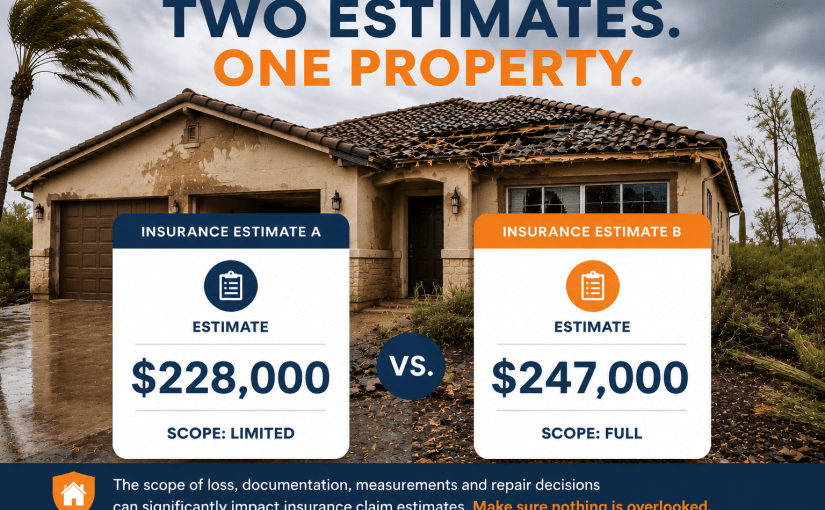
One estimate says the repairs will cost $228,000.

Another says $247,000.

That is almost a $20,000 difference for what looks like the same loss.

Most homeowners would naturally wonder how two people could look at the same property and come up with numbers that far apart.

The answer is often not simply the price of labor or materials.

It may be what each person believes is necessary to complete the repairs.

In insurance claims, that is often referred to as the scope of loss. In plain English, it is the detailed list of work needed to repair the damage.

Here is a clear description of Scope of Loss from United Policyholders (UP), a non-profit 501(c)(3) whose mission is to be a trustworthy and useful information resource and a respected voice for consumers of all types of insurance across the United States. They don’t sell insurance or take money from insurance companies. They give you the straight scoop….Guide you on buying insurance and navigating claims…Fight for your rights.

And that scope of loss list matters just as much as the prices attached to it.

Ideally, you shouldn’t have to get to the point where you’re trying to figure out why two estimates are so far apart. Understanding how estimates are built also helps explain why we believe a public adjuster can be most helpful when involved from the beginning.

Start With the Work, Not the Number

Take a water-damaged kitchen.

You may walk in and immediately see wet flooring and damaged drywall. But repairing that kitchen may involve much more than what you can see.

Are the cabinets damaged? Does the countertop need to be removed to work on them? Is there damage behind the cabinets? Does insulation need to be replaced? Do appliances have to be disconnected and moved?

And once damaged materials are removed, what has to be done to put everything back together?

Those questions all affect the estimate.

So when one estimate is $228,000 and another is $247,000, looking only at the totals does not tell you very much.

The better question is:

Are both estimates actually including the same work?

A Difference in Scope Can Create a Big Difference in Price

Suppose one estimate includes replacing 2500 square feet of flooring and another includes 2900 square feet.

Even if both use exactly the same price per square foot, the totals will be very different.

That is not really a disagreement about the price of flooring. It is a disagreement about how much flooring needs to be replaced.

The same thing can happen with drywall, paint, cabinets, insulation, trim, roofing and other repairs.

The differences can add up quickly.

The Repair May Involve More Than What Was Damaged

If water damaged drywall behind built-in kitchen cabinets, you cannot repair the wall without getting to it. That may mean removing cabinets or a countertop, repairing the wall and then putting everything back.

The same thing can happen when plumbing inside a wall needs to be accessed. The wall may have to be opened and later repaired, textured and painted.

There can also be differences over whether something should be repaired or replaced.

One person may believe part of a cabinet system can be repaired. Another may believe more extensive work is necessary. Similar questions can arise with flooring, roofing, countertops, doors, trim and other materials.

These decisions can make a significant difference in the final estimate.

Small Things and Measurements Matter Too

Property repairs involve many individual steps.

Furniture may need to be moved. Appliances may need to be disconnected and reconnected. Baseboards may need to come off and go back on. Fixtures may need to be removed and reset. Areas that aren’t being repaired may need protection. Debris needs to be removed.

One missing item may not change an estimate very much. A number of smaller items can.

Measurements matter too.

One estimate may show 1600 square feet of flooring while another shows 1725. Room dimensions, roof measurements, and linear feet of trim can all differ.

Sometimes the issue isn’t what something costs.

It’s what is being included in the first place.

Not All Damage Is Visible Right Away

You may not be able to see the full extent of property damage during the first inspection.

Water can travel underneath flooring, behind cabinets and inside walls. Sometimes additional damage isn’t discovered until materials are removed.

An estimate is based on the information available at the time it is prepared. If additional damage or necessary work is discovered later, the scope and estimate may need to be updated.

This is one reason documentation from the beginning is so important.

Photographs, video, measurements and detailed records can help preserve what the property looked like before conditions change.

Of course, necessary steps to protect the property from further damage should not be delayed simply for documentation. The point is to document what you reasonably can while also taking appropriate steps to protect the property.

So Which Estimate Is Correct?

The higher estimate is not automatically right.

The lower estimate is not automatically right either.

One may include more necessary work. Additional information may be needed. Or two experienced people may simply disagree about what repairs are required.

What matters is understanding the reason for the difference.

If you ever find yourself looking at two very different estimates, understanding what is behind the numbers can help explain the difference.

Are the same areas included? Are the measurements the same? What is being repaired and what is being replaced? What has to be removed to reach the damage? What has to be put back afterward? Is work included in one estimate that doesn’t appear in the other?

You may discover that the two estimates aren’t actually estimating the same job.

But ideally, we believe the scope of the loss should be carefully developed and documented from the beginning rather than waiting until there are two very different estimates and trying to determine why.

Getting the Scope Right From the Beginning Matters

At AJR Public Adjusters, we would much rather see a significant property loss at the beginning than be called months later when conditions have changed and everyone is trying to figure out why the estimates are so different.

The property itself is where we want to start.

When we’re involved early, we can inspect the damage, photograph and measure it, review the policy, document the loss and develop a detailed scope and estimate based on our inspection.

We want to start with the property, not someone else’s number.

Our preference isn’t to come into a claim after the fact and simply compare our number with someone else’s. We would rather have the opportunity to inspect and document the loss ourselves from the beginning.

Our job is to document the damage, develop a detailed scope and estimate, and properly present the claim to the insurance company based on the policy.

Why Experience Matters From the Start

Bruce Horowitz, has been adjusting property insurance claims for more than 38 years.

Experience does not change the damage. It changes what you know to look for.

And experience doesn’t mean automatically including more. It means knowing what questions to ask and what details need to be considered.

A homeowner may walk into a damaged kitchen and see wet flooring and damaged cabinets.

An experienced adjuster may also be thinking about what is underneath the flooring, what is behind the cabinets, what needs to be removed, what has to be disconnected and what will have to be put back when repairs are finished.

Those questions are much easier to address while the conditions can still be observed and documented than months later after the property has changed and repairs have begun.

That is why we encourage property owners to consider whether they want professional representation at the beginning of a significant property loss.

You do not need to wait for the insurance company to prepare its estimate.

You do not need to wait until you disagree with that estimate.

And you do not need to wait until the claim becomes frustrating.

As early as possible, before conditions change and the claim gets too far underway, that is the time to decide whether you want someone representing your interests in the adjustment of the loss.

If you’re considering hiring a public adjuster, the beginning of the claim is the best time to make that decision.

AJR Public Adjusters offers an initial consultation at no charge. We can discuss what happened and whether having us involved from the start makes sense.

AJR Public Adjusters
602-795-5227
publicadjusteraz.com

About the Author

Stacy K. Horowitz is co-owner and manager of AJR Public Adjusters, LLC, which she operates with her husband, Bruce L. Horowitz. Bruce has more than 38 years of property adjusting experience, and AJR has represented Arizona property owners for more than 13 years.

Stacy writes about property insurance claims to help Arizona homeowners and business owners better understand a process most people know very little about until they experience a loss themselves.

This article is for general educational and informational purposes only. It is not legal or insurance coverage advice and does not guarantee coverage or the outcome of a claim. Every insurance policy and claim is different.

Can a Public Adjuster increase My Insurance Settlement?

How Much More Money Can a Public Adjuster Get Me?

One of the most common questions we hear is:

“How much more money can you get me?”

It’s a fair question. If you’re considering hiring a public adjuster, you want to know whether the cost is worth it.

The honest answer is that no ethical public adjuster can guarantee a specific increase in your settlement. Can a public adjuster sometimes help increase a settlement? Absolutely.

We often see situations where damages were overlooked, not fully documented, or not included in the original estimate. When covered damages are properly identified and presented, the settlement may increase.

However, every claim is different. That is why no ethical public adjuster can predict a specific outcome before reviewing the property, the damages, and the insurance policy.

In fact, if someone promises they’ll get you 300%, 500%, or 700% more before they’ve even reviewed your property, policy, and damages, you should ask a few more questions.

Why No One Can Predict the Outcome

Every insurance claim is different.

Every property is different.

Every insurance policy is different.

Every loss is different.

To accurately compare claim results, you would need the exact same:

  • Property
  • Insurance policy
  • Damages
  • Documentation
  • Timing
  • Insurance company
  • Insurance adjuster

That almost never happens.

The moment a public adjuster becomes involved, the claim changes.

Damages may be documented differently.

Additional covered damages may be identified.

Estimates may be more detailed.

Personal property losses may be better documented.

The claim may be presented and negotiated differently.

Because of that, nobody can know what the final settlement would have been if the public adjuster had never been involved.

The Problem With Percentage Claims

You may see advertisements that say:

  • “We get policyholders 300% more.”
  • “Our clients receive 523% higher settlements.”
  • “We increase claims by an average of 700%.”

The real question is:

Compared to what?

Was the original insurance estimate complete?

Had all damages been identified?

Were code upgrades included?

Was personal property accounted for?

Were additional living expenses considered?

Had the claim been fully documented?

Without knowing the details of every claim, those percentages don’t tell the whole story.

Insurance claims are not standardized products. They are unique situations with dozens of variables. Reducing every claim to a single percentage can be misleading.

What a Public Adjuster Actually Does

A public adjuster’s job is not to create money.

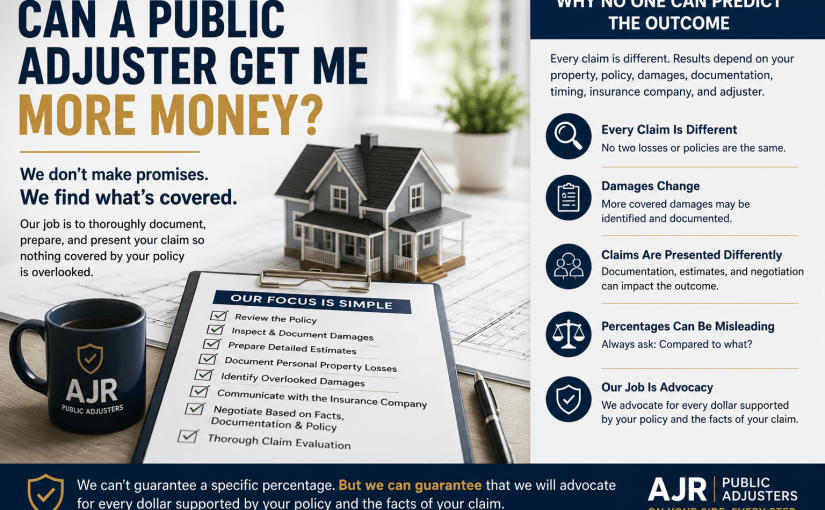
Our job is to properly document, prepare, and present the claim under the terms of the insurance policy.

For example, a homeowner may report damage from a water leak, and the insurance company may estimate repairs only for the visible drywall. During a detailed inspection, damage to flooring, cabinetry, insulation, or personal property may also be discovered. When covered damages are properly documented and presented, the settlement may increase. That isn’t because the public adjuster created money. It’s because additional covered damages were identified and documented, and presented to the insurance company.

That includes:

  • Reviewing the policy
  • Inspecting and documenting damages
  • Preparing detailed estimates
  • Documenting personal property losses
  • Identifying potentially overlooked damages
  • Communicating with the insurance company
  • Negotiating based on facts, documentation, and policy language

The goal is to help ensure that all covered damages are identified, documented, and properly evaluated.

A Better Question to Ask

Instead of asking:

“How much more money can you get me?”

Consider asking:

  • Have you handled claims like mine before?
  • How will you document my damages?
  • What is your process?
  • How often will you communicate with me?
  • Will I be able to reach you directly?
  • How involved will you be throughout the claim?

The answers to those questions often tell you much more about the value a public adjuster provides.

When Should You Hire a Public Adjuster?

Many policyholders don’t realize that the best time to involve a public adjuster is often at the very beginning of the claim.

Once a claim is reported, important decisions start being made. Damages are documented, inspections are scheduled, estimates are prepared, and information is submitted to the insurance company.

Bringing in a public adjuster early can help ensure the claim is properly documented from the start and may help avoid issues that can arise when damages are overlooked or when incomplete information is provided.

Remember, the insurance company has professionals representing its interests throughout the claims process. Having your own professional representative can help level the playing field and provide guidance through what is often a stressful and unfamiliar process.

While a public adjuster can become involved at various stages of a claim, many policyholders find that engaging one early helps reduce confusion, avoid unnecessary headaches, and ensure the claim is thoroughly prepared from day one.

Final Thoughts

No public adjuster can honestly guarantee a specific settlement amount or percentage increase.

What we can promise is that we will thoroughly review the loss, document the damages, and advocate for the policyholder throughout the claims process.

At AJR Public Adjusters, we believe communication is just as important as documentation. Our clients are kept informed throughout the claims process and are copied on communications, so they always know where their claims stand.

That commitment to service has helped us maintain an A+ rating with the Better Business Bureau and earn numerous positive reviews and testimonials from homeowners and business owners who have trusted us to represent their interests.

Every claim is unique, and the outcome depends on the facts, the policy, and the damages involved.

If someone promises a specific percentage increase before reviewing your property, policy, and loss, ask how they could possibly know that.

What matters isn’t a promised percentage. What matters is whether your claim is being properly documented, thoroughly presented, and fully evaluated under the terms of your policy.

At AJR Public Adjusters, our focus is simple: help policyholders understand their coverage, thoroughly document their damages, keep them informed throughout the process, and advocate for every dollar supported by the policy and the facts of the claim.

Navigating Property Insurance Claims: Why Public Adjusters Matter

When people think about an insurance claim, many assume the insurance company will simply inspect the damage, write a fair estimate, and pay what is needed to put everything back together. In reality, the process is often far more complicated.

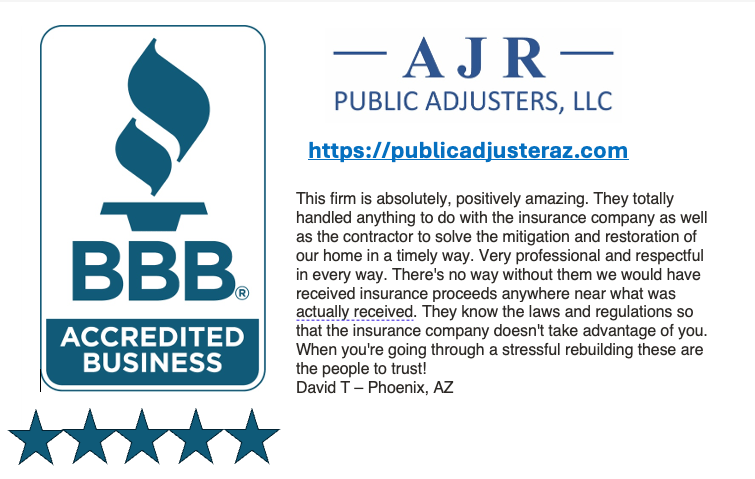
One recent Better Business Bureau review highlights an issue many policyholders face after property damage. The client wrote:

“This firm is absolutely, positively amazing. They totally handled anything to do with the insurance company as well as the contractor to solve the mitigation and restoration of our home in a timely way. Very professional and respectful in every way. There’s no way without them we would have received insurance proceeds anywhere near what was actually received. They know the laws and regulations so that the insurance company doesn’t take advantage of you. When you’re going through a stressful rebuilding these are the people to trust!”

This review points to several important realities about property insurance claims and why many homeowners choose to hire a public adjuster.

Understanding the Insurance Claim Process

After a fire, water loss, storm, or other property damage, most homeowners are suddenly faced with:

  • documenting damage
  • reviewing insurance estimates
  • communicating with contractors
  • understanding policy language
  • responding to insurance company requests
  • tracking deadlines and payments

At the same time, they are often trying to manage daily life, temporary living arrangements, work obligations, and the emotional stress that comes with property damage.

Insurance companies have professional adjusters handling claims every day. Their job is to evaluate the loss for the insurance carrier. A public adjuster works for the policyholder.

Why Documentation Matters

One of the biggest issues in insurance claims is incomplete documentation.

Damage is not always obvious during an initial inspection. Water can spread behind walls and under flooring. Smoke damage can affect contents throughout a property. Important repair items may be overlooked if they are not properly identified and documented.

A public adjuster’s role often includes:

  • thoroughly documenting damage
  • reviewing repair estimates
  • identifying missing items
  • reviewing policy coverages
  • communicating with contractors and mitigation companies
  • negotiating with the insurance company

The goal is to make sure the claim reflects the actual damage and policy benefits available.

Managing Communication During a Stressful Time

Another important point raised in this BBB review is how valuable it can be to have someone manage communication during the rebuilding process.

Many policyholders are unfamiliar with insurance terminology, restoration procedures, or claim requirements. Questions from contractors, mitigation companies, and insurance representatives can quickly become overwhelming.

A public adjuster helps coordinate and organize the process so the homeowner is not left trying to handle every issue alone.

Knowledge of Policy and Claim Procedures

Insurance policies contain detailed language regarding coverage, exclusions, limits, depreciation, and claim obligations. Most people do not deal with these issues regularly.

An experienced public adjuster understands:

  • how policies are structured
  • what documentation insurers typically require
  • how estimates are reviewed
  • how depreciation works
  • how supplemental claims are submitted
  • how claim disputes are addressed

This knowledge can help prevent important items from being missed or undervalued.

The Importance of Early Involvement

One of the most important lessons homeowners can take away is that early involvement matters.

Decisions made at the beginning of a claim can affect the entire process, including:

  • mitigation
  • documentation
  • repair scope
  • inventory preparation
  • settlement negotiations

Getting professional guidance early can help avoid problems that become harder to correct later.

At AJR Public Adjusters, we believe policyholders should fully understand their rights and options during the insurance claim process. An insurance loss is stressful enough. Having experienced representation can help homeowners stay informed, organized, and properly represented from start to finish.

First 48 Hours After Property Damage: Essential Steps

What to Do in the First 48 Hours After Property Damage

When something goes wrong in your home, a leak, fire, storm, or sudden water damage, the first two days matter more than most people realize.

What you do right away can affect your entire insurance claim.

Here’s a simple checklist.

1. Make it safe first

If there’s standing water, exposed wiring, or structural damage, focus on safety. Shut off water or power if needed. If the home isn’t safe, don’t stay inside.

2. Take photos and video before cleanup

Grab your phone and document everything.

Wide shots of rooms.

Close-ups of damage.

Damaged furniture, flooring, cabinets, walls, ceilings.

Do this before anything gets moved or dried out. Once it’s gone, it’s hard to prove.

3. Don’t throw damaged items away

Even if something looks ruined, keep it until your claim is documented. Insurance companies often want proof. Tossing items too early can cost you money.

4. Start a basic list of damaged items

You don’t need perfection. Just start writing things down. Furniture. Clothing. Kitchen items. Electronics. Every little thing adds up.

Most homeowners underestimate contents losses by thousands.

5. Avoid hiring contractors too fast

Some contractors push hard right after a loss. Take your time. Get estimates. Don’t sign contracts that assign your insurance benefits unless you fully understand what that means.

6. Know who your adjuster works for

The insurance adjuster works for the insurance company.

A public adjuster works for you.

That’s where AJR Public Adjusters comes in. Our job is to document your damage, prepare your claim properly, and negotiate so you’re paid what your policy allows, not just what the carrier offers.

7. Set up your claim for success

These steps help protect your claim, but the best way to make sure nothing is missed is to hire a public adjuster right away. A good public adjuster handles the documentation, values your damage properly, and deals directly with the insurance company so you don’t have to.

Before hiring anyone, take a few minutes to research. Look at references and client testimonials. Check their standing with the Better Business Bureau. It’s one of the easiest ways to see how a company treats people and whether they follow through.

AJR Public Adjusters works only for policyholders. We make sure your loss is fully documented and your claim reflects what your policy allows, not just what’s offered at the start.

Getting help early can prevent costly mistakes and protect thousands of dollars most homeowners never realize they’re leaving on the table.

Monsoons, Microbursts, kitchen leaks, it adds up fast. Make sure your settlement does too. Valley homeowners deserve full settlements not quick checks. Don’t leave money behind.

CALL AJR FIRST – 602-795-5227

Why Personal Attention Matters in Property Damage Claims

A recent client shared a reminder of why personal attention matters in this industry:

“Bruce is simply the best…His coordination with the mitigation company was crucial in preventing even more damage when my roof collapsed…I would highly recommend Bruce and AJR…. Don’t go it alone.”

Property damage is confusing and urgent. When someone’s roof collapses or water spreads through a home, they shouldn’t have to fight an insurance company at the same time. Having someone manage the claim, coordinate mitigation, and protect coverage can completely change the outcome.

At AJR Public Adjusters LLC– Representation for you NOT insurance company for real property claims —we believe every policyholder deserves direct guidance, not a call center. Bruce Horowitz handles each claim personally, start to finish, because your home is too important for guesswork.

Grateful for the trust our clients place in us. We’ll always be here when the unexpected happens.

Protecting Policyholders: Our Commitment at AJR Public Adjusters

Integrity Isn’t an Option—It’s the Standard at AJR Public Adjusters

Every so often, a review reminds us why we do what we do.

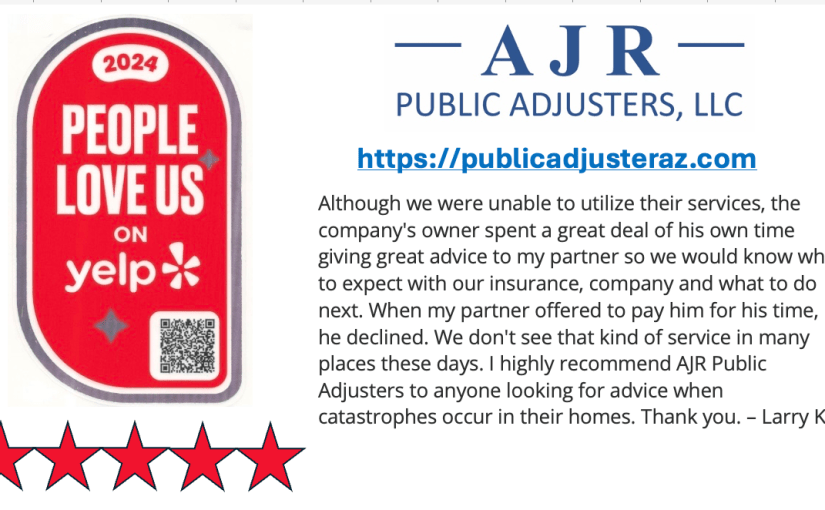
Recently, a homeowner, Larry K., shared how Bruce took the time to walk him through the insurance claim process—even though AJR couldn’t take on his particular claim. When Larry offered to pay for his time, Bruce politely declined. As Larry put it, “We don’t see that kind of service in many places these days.”

That sentiment perfectly reflects what AJR Public Adjusters stands for: genuine care, professional guidance, and doing what’s right—whether or not someone becomes a client. It’s about integrity, not transactions.

We know that when property damage happens—whether from fire, flood, or storm—people feel overwhelmed. The insurance process is confusing, with tight deadlines, and it’s hard to know who to trust. That’s why we lead with honesty first. Even if we can’t formally represent someone, we believe sharing guidance and clarity has real value.

At AJR Public Adjusters, our goal isn’t just to settle claims—it’s to help policyholders understand their rights and make informed decisions. With more than 37 years of experience in insurance claim recovery, Bruce has seen how the slightest bit of clear direction can change the entire outcome of a situation.

We’re proud that clients and callers alike describe us as responsive, transparent, and knowledgeable. Whether we’re managing a complex fire loss or simply explaining next steps to a homeowner, our focus stays the same:

Protect the policyholder, not the insurance company.

That commitment has earned us an A+ BBB rating, but more importantly, it’s earned trust—something we never take for granted.

So to Larry and others who’ve taken the time to share their experiences, thank you. Your words remind us that professionalism, kindness, and integrity still make a difference—and they always will at AJR Public Adjusters.